Saturday, February 12, 2011

Kanto Matsuri (Lantern Festival) - August 2008


In August of '08 while still in Misawa, Japan we completed the trifecta of the area's (and Japan's) best festivals by attending the Kanto Matsuri with Alan. We spent the better part of the day trying to find a camping sight due to the immense popularity of the festival. We finally found one just outside of town at some sort of family park complex that had a water park.


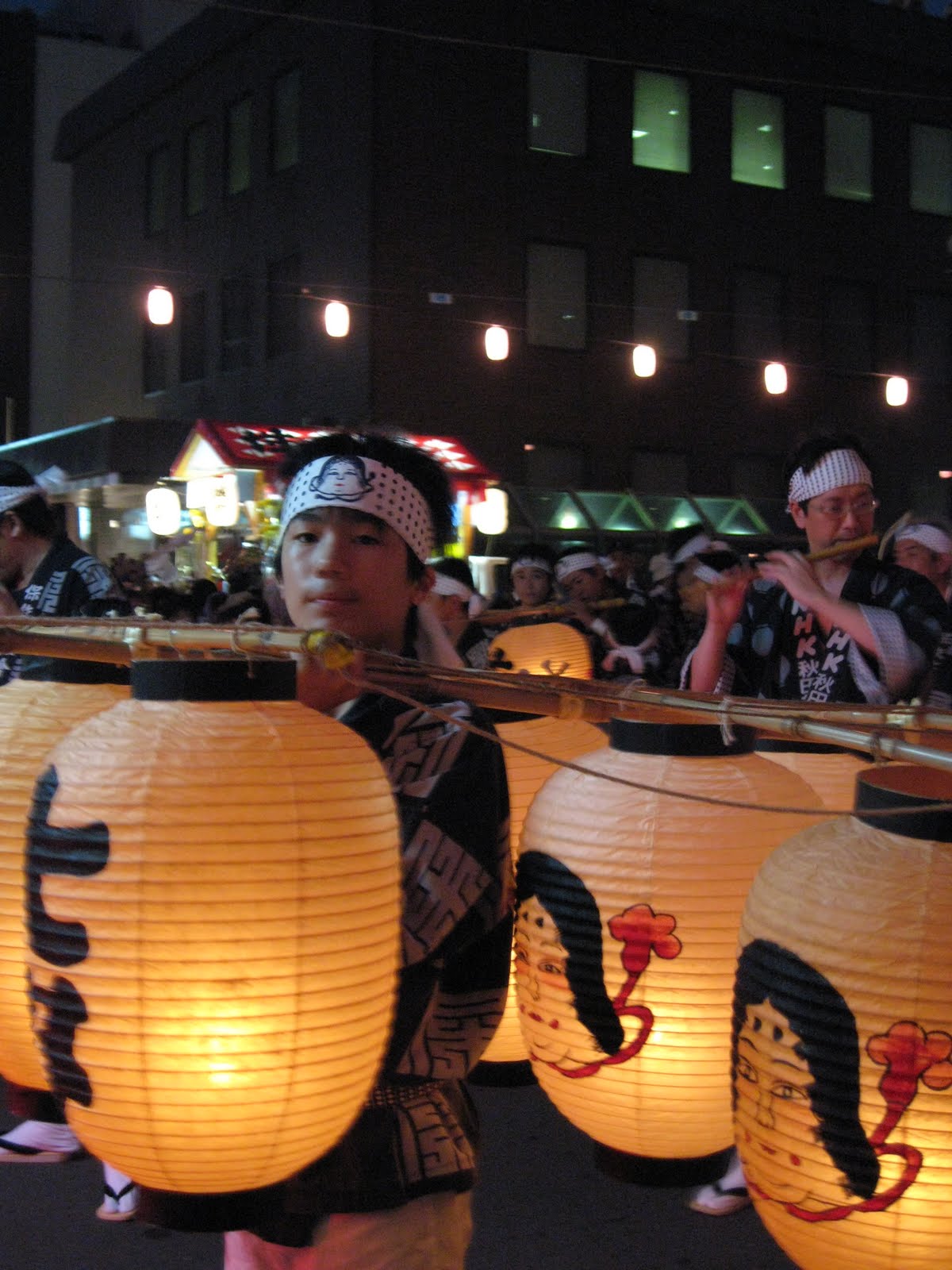
We made our way into town braving the rain to see the lantern parade with 400,000 others (the festival generally gets about 1.3 million visitors a year). Along with the lantern toters there were your typical Japanese festival fare.


Luckily, we were able to scope out a pretty good spot right along the avenue of the parade. The lanterns (which weigh around 115 lbs and are about 36 ft long) are passed from man to man and carried on the hip, forehead, hand and shoulder.


Unlike most of the festivals in Japan, this one actually had an element of danger added to it.  While the lantern carriers were quite skilled at balancing these lighted beauties, sometimes they did drop all 36 feet of them.  Luckily we were standing under a high line that caught the falling projectiles.


Below is a video illustrating the dangerous nature of being a spectator at this festival and how the line saved us.


The morning after spending a rain drenched night at the campsite (in which Alan and I polished off a bag of Nacho Cheese Doritos in the Surf as evidenced by orange crumbs all over the car) we set off up the west coast of Japan.


In this region of Japan there is some fable of these crazy dressed people.  We never figured out exactly what they were, but as you can see they were friendly and photogenic.


In true Japanese ingenuity, a couple of construction traffic control robots.


And before we headed home, we stopped off to check out the rice art (as seen in a previous post).

Read more »

Labels: , , , ,

Sunday, February 06, 2011

Kyoto July 16-19, 2008


When we got to Kyoto it was the night before the final parade of the Gion Matsuri, one of Japan's most well known festivals. We didn't really plan on doing this, it just worked out that way.


All of downtown Kyoto was blocked off for pedestrian traffic only. All of the floats were on display along with countless food vendors and girls with kimonos.


One of the interesting things about this festival is that families will put family heirlooms on display for all to see. Kyoto's streets basically become a free museum of antique kimonos and artwork.


Since everyone in Kyoto was wrapped up in the festival, it made shrine hopping virtually tourist free for the most part. Our first stop was a short walk from our business hotel. Probably best known for the hundreds of torii gates, Fushimi Inari shrine was definitely one of our favorites.


Started in 790 this Shinto shrine boasts over 10,000 torii gates (and I think we saw everyone of them).


After getting our share of torii gates we stopped by Ginkakuji Temple (Silver Pavilion built in the late 1400's). Although it's called the silver pavilion, it was never covered in silver.


When we were there the main pavilion was under renovation, but we still got to see the gardens.


Tornado potato anyone?


Our next stop was the Heian Jingu temple. This temple was built in 1895 in celebration of Kyoto's 1100th birthday.


Stacks of sake barrels like above represent donations of patrons at Shinto shrines.


These 'paper prayers' are common at temples and shrines in Japan.


When you come to the fork in the road...


The gardens at Heian Jingu were massive and well manicured. They also had hazardous water crossings...in case and so on.


Luckily balance prevailed and we continued on our tour.


More gardens at Heian Jingu.


Another one of the temple complexes we visited was the Kiyomizudera temple. Established in 790, the buildings of the complex date back to the 1600's. As you can see, the temple sits on the hillside giving great views of Kyoto.


In the temple complex are three waterfalls called Otawa no taki. You drink from these for health, longevity, and wisdom respectively. However, you're only supposed to drink from two of them. If you drink from all three you're seen as greedy and misfortune will fall upon you...oops, I was thirsty.


Although we'd seen fountains like this at other shrines in Japan, this was the first one we saw people bringing plastic jugs to fill with the water.


Another interesting part of the temple complex is a shrine dedicated the god of love and match making. In this shrine are two rocks that are about 30 ft apart. If you navigate between the two rocks with your eyes closed you'll find your true love. Let's see how Amy did...


The main complex of the temple (above) is made entirely without any type of nail. It's supported by 139 pillars 49 ft tall. During the Edo period if you jumped off and survived your wish would be granted. Of the 234 who attempted the jump, 85.4% survived.


One of the more interesting places in Kyoto was the Gion Shimbashi. This area is the best example of the Edo period tea houses with the bamboo shades covering the house fronts.


At night we got to glimpse three geisha. Since there are only about 1,100 left, we consider ourselves lucky to have seen some. It's easy to see why this area was one of the main locations for shooting Memoirs of a Geisha.


We did get to eat dinner in one of the tea houses. It was pretty much filled with tourists (both Gaijen and Japanese), but the food was good.


The Kinkakuji (Golden Pavilion) was originally built as a retreat for a shogun in the 1300's. Eventually it was converted to a Buddhist temple. It has been burned to the ground a few times, the most recent incident by a crazy monk in 1955.


The most underwhelming of the 'must see' temples was the Ryoanji Temple. In the land of Buddha, it is supposedly the most zen of locations. Don't get me wrong, it was a cool rock garden. It was built in the 1400's, and it has also been designated a World Heritage Site.

Another UNESCO site, the Toji temple boasts the tallest wooden pagoda in Japan. Originally built in the 8th century, the present pagoda dates back to the 1600's


A good reminder for all of us thinking of scribbling on priceless treasures of Japanese culture.


The Sanjusangendo Temple boasts the longest wooden building in Japan. But the real attraction here are the 1,001 Kannon statues covered in gold leaf. All of them were individually carved from Japanese Cyprus trees around 1264 AD. Photography was prohibited inside the building...oops.

Labels: , , , , ,

Tuesday, February 10, 2009

Rock Climbing at Kuji


This past June a couple of our friends (Scott and Jen) invited us and a couple of others to go rock climbing with them. Amy had done some before on a climbing wall, but I had no previous experience. So, this was our first experience up a true rock face.


Several of them were experienced climbers, so they had all the necessary equipment we needed. The location was just outside of a town called Kuji on the east coast of Japan. It's definitely a beautiful location (a large stretch of nearby coast has been designated as a national park).


It was amazing how steep a face you could climb up and how much energy it took. Amy and I couldn't make it to the top on the first try, but on the second one we made it. One piece of advice I would give anyone doing this is to wear pants. It pretty much trashed my knees.


The method was quite simple. The climber wore a harness around the waist/legs and you tied one end of the rope to the harness (which was double checked). The rope was put through a ring at the top of the cliff and the rest of it was controlled by someone sitting on the ground. The person on the ground pretty much had your life in their hands, so you didn't spit on them.


Once you got to the top, you were rewarded with some amazing views of the coastline. Fortunately, no injuries occurred and fun was had by all.


The only time there was a risk of injury was when I tried this "Cliffhanger" move to start my first climb...I almost landed it


Labels: , , , ,

Mt Fuji

This past July Amy and I decided it was time we tackled the iconic Mt Fuji. We caught a bus from Tokyo in the morning and arrived at Lake Kawaguchi at around lunch time. We took a shuttle to our hotel and tried to sleep the whole afternoon. During the summer months, view of Mt Fuji are rare. So we were excited to see this view from our hotel the night we were to hike it.
We had debated whether or not to hike at night or during the day, but decided to go with the former to catch the sunrise from the top. We caught a bus from the train station to the starting point of the hike. There are several routes up and down the mountain. We took the Kawaguchiko trail starting at the 5th station at about 2,200 meters. For most of night we were alone on the trail, only occasionally passing or getting passed by someone. There were large amounts of people at the huts along the trail (many people hike part way, stay the night, and hike to the top in the morning).

We were zipping up the trail at a pretty good rate. The weather was perfect, with barely a cloud in the sky. It was a little choppy sometimes with the visibility (we only had our headlamps), but for the most part the trail is very easy to navigate. There were only a few times we had to climb hand over foot.


Things were going great...until a little thing called altitude sickness jumped on Amy's back at about 3,200 meters. At this point our pace slowed a bit to allow Amy to let go of some of her lunch/dinner and to rest. After our break the throngs of Japanese climbers had already emerged from their slumber from the mountain huts, and we were forced to get in line for the final ascent.


Despite Amy's bad fortune with the altitude sickness and the slow line to the top, we still made the 5,000 ft climb in a little over 5 hours to 3,776 meters (12,388 ft). And we made it in time for the sunrise. I wasn't sure it was worth it to climb at night (Amy still doesn't think so), until I saw it...I really don't know if it was that beautiful, or if I was just happy to be at the top.


After taking a two hour nap at the summit in one of the ramen huts, we started our descent. Fortunately we had little cloud cover, so the views were great. Once again, we had to take it easy on the way down since Amy was a little dehydrated from the extraneous efforts altitude put on her. Despite that, we still made it down in three hours.


Going down the trail was a little more crowded. As all the mountain hut sleepers were now making their way down. The down trail was a little different terrain than the up trail, too. While on the ascent you were hiking on pretty solid rock, the descent was pretty much on sand.

It felt like I had corneal abrasions by the end. It was like we were hiking at the beach. We had sand in every bit of clothing we had on.


Although Amy had to take it easy, I found it much more fun (and annoying to other hikers) to run down the sand switchbacks. I could then catch my breath while Amy came down, then I would run by the same before mentioned annoyed hikers. This sequence lasted through the first 1/3 of the descent.


When we got back to the 5th station, we caught a bus back to the train station and then a taxi back to our hotel. There we enjoyed a nice dip in the onsen to soothe our weary muscles. I must add that our hotel had one of the coolest things I've ever seen...just watch the video to find out.

Labels: , ,